Who is responsible, and from what day
In Great Britain the framework is the Construction (Design and Management) Regulations 2015, usually shortened to CDM 2015. The regulations deliberately place welfare duties on more than one person at once, so nobody can point at somebody else while workers go without a toilet.
The commercial client must ensure that suitable welfare arrangements are in place before work starts and are maintained throughout the project. The client does not have to provide the facilities personally, but they cannot let a project begin without them.
Every contractor must ensure that the Schedule 2 welfare facilities are provided for workers under their control from the start of the work. Where a project has more than one contractor, the principal contractor carries the duty to ensure those facilities are in place for the whole construction phase.
Two points catch people out:
- Day one means day one. There is no grace period while the site is set up. Facilities must be available from the first day workers are on site, which is why welfare units and portable toilets are so often booked to arrive with the fencing.
- Domestic projects are not exempt. Where the client is a domestic householder, CDM 2015 transfers the client duties to the contractor, or to the principal contractor if there is more than one. A builder on a house extension owes the same welfare duties as a principal contractor on a distribution warehouse. Relying on the homeowner's bathroom can be acceptable for a short job if the householder genuinely agrees, but that is an arrangement to confirm, not to assume.
For fixed workplaces such as offices and depots, the parallel requirements sit in the Workplace (Health, Safety and Welfare) Regulations 1992; construction sites are temporary, which is why CDM 2015 carries its own schedule.
The Schedule 2 checklist in plain English
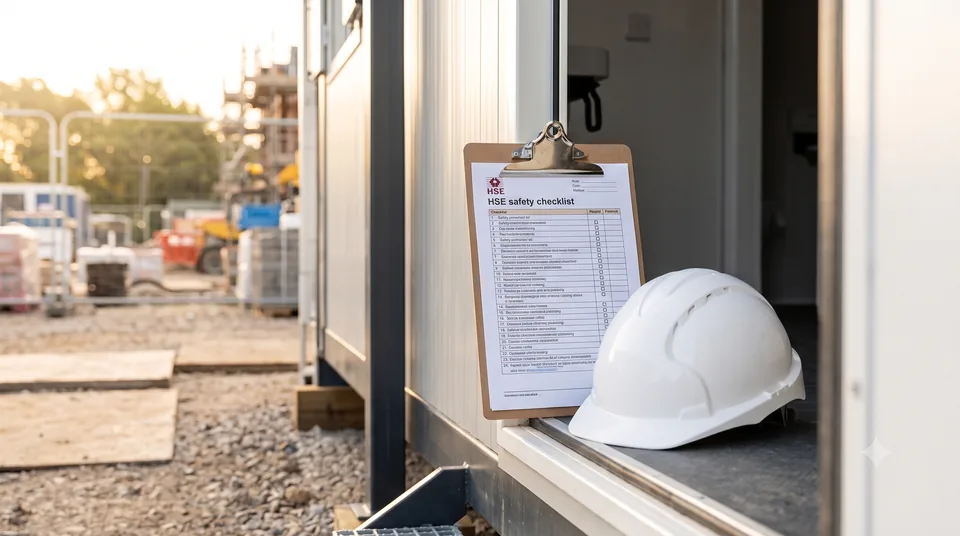
Schedule 2 of CDM 2015 lists the minimum welfare facilities for construction sites. Stripped of the legal drafting, it requires the following.
- Toilets. Suitable and sufficient sanitary conveniences at readily accessible places, adequately ventilated and lit, and kept clean and orderly. Separate rooms for men and women are expected unless each convenience is in a separate room that can be secured from the inside.
- Washing facilities. Suitable and sufficient washing facilities, including showers if the nature of the work requires them, so far as is reasonably practicable. They must be in the immediate vicinity of the toilets and any changing rooms, with clean hot and cold, or warm, running water, soap or another cleaning agent, and towels or another means of drying.
- Drinking water. An adequate supply of wholesome drinking water, readily accessible, clearly marked where necessary, with cups or another drinking vessel unless it comes from a jet.
- Changing rooms and lockers. Where workers have to wear special clothing and cannot reasonably be expected to change elsewhere, changing rooms must be provided, separate or used separately by men and women where propriety requires, with facilities for drying wet clothing and for securing personal belongings.
- Rest facilities. Suitable and sufficient rest rooms or rest areas, with enough tables and seating with backs for the number of workers likely to use them at any one time. There must be arrangements, where necessary, for pregnant women and nursing mothers to rest lying down, a means of preparing or obtaining hot drinks, and facilities for eating meals, including a means of heating food where hot food cannot otherwise be obtained.
Notice what is not on the list. Schedule 2 does not name a number of toilets, a tap temperature or a cabin size. It sets outcomes. The numbers come from guidance, covered next.
How many toilets for how many workers
This is the question every site manager asks, and the honest answer is that the law states no ratio for construction sites. CDM 2015 requires facilities that are suitable and sufficient for the number of people expected to use them. What counts as sufficient is judged against recognised guidance, and the usual benchmark is British Standard BS 6465-1 on sanitary installations.
For temporary sites without mains drainage, the widely used rule of thumb drawn from that guidance is one chemical toilet and one washbasin for every seven workers, based on a unit serviced about once a week. Service the units more often and a single toilet can reasonably cover more people. Where flushing toilets connected to mains drainage or a suitable tank are available, the scale published in the Approved Code of Practice to the Workplace (Health, Safety and Welfare) Regulations 1992, known as L24, is commonly applied instead.
| People at work (mixed use or flushing WCs) | Toilets | Washbasins |
|---|---|---|
| 1 to 5 | 1 | 1 |
| 6 to 25 | 2 | 2 |
| 26 to 50 | 3 | 3 |
| 51 to 75 | 4 | 4 |
| 76 to 100 | 5 | 5 |
Treat these figures as planning guidance rather than legal minima. An inspector is not counting cubicles against a statutory table, because no such table exists in CDM 2015. What the inspector is judging is whether queues form, whether units are overflowing between services, and whether provision matches peak headcount rather than the average. A site that peaks at forty workers during a concrete pour needs provision for forty, not for the fifteen who are there most weeks.
Two practical adjustments are worth building in. If the workforce includes women, provision must work for them, either through separate facilities or single lockable self-contained units. And servicing frequency is part of the calculation: plenty of units on a fortnightly service can be worse than fewer units serviced twice a week.
What suitable and sufficient means in practice
Suitable and sufficient is the phrase that carries all the weight in Schedule 2, and HSE guidance fills in what it looks like on the ground. A facility that exists but is unusable does not count.
- Kept clean. Toilets and washing facilities must be maintained in a clean and orderly condition. On a hired unit that means a servicing contract matched to usage, plus somebody on site responsible for their state between services.
- Lit and ventilated. Both are explicit Schedule 2 requirements. A dark unit at the far end of a winter site fails the test even if it is spotless.
- Warm water, not just cold. Washing facilities must include hot and cold, or warm, running water so far as is reasonably practicable. Hot-wash units with onboard water heating are a standard hire product, so cold-only handwash needs a genuine justification, not a cheaper quote.
- Flushing where you can. HSE guidance expects flushing toilets and running water wherever reasonably practicable, by connecting to mains drainage or using units with integral tanks. Chemical-only toilets are the fallback for locations where that genuinely cannot be achieved, not the default because they are cheapest.
- Readily accessible. Facilities should be close enough to the work that people will actually use them. On a long linear job such as a highways scheme, that may mean units at intervals along the route.
- Available to everyone on site. That includes subcontractors, delivery drivers held on site for long periods, and visitors.
A useful self-test: would you use the facilities yourself, every day, in February? If the honest answer is no, the provision is unlikely to satisfy an inspector either.
Welfare units, separate hires, and short or transient sites
There are two common ways to meet Schedule 2 on a temporary site, and the right choice mostly comes down to headcount, duration and services.
Separate hires means assembling the provision from individual products: portable toilets, a standalone handwash or hot-wash unit, a canteen or rest cabin and a drying room. This suits longer sites with mains water, drainage and power, because it scales unit by unit and each element can be upgraded independently.
All-in-one welfare units pack the whole schedule into a single towable or static cabin: toilet, hot-water handbasin, seated rest area with a table, a means of heating water and food, and drying space, typically powered by a generator or a solar and battery system with integral fresh and waste tanks, so they work on sites with no services at all and can be in use the day they arrive.
| Factor | All-in-one welfare unit | Separate toilet, wash and rest hires |
|---|---|---|
| Typical crew size | Up to about 7 to 12 depending on model | Any size, scales by adding units |
| Site services needed | None, self-contained | Usually benefits from water, drainage or power |
| Setup time | Same day, one delivery | Multiple deliveries and connections |
| Best for | Short jobs, mobile crews, sites without services | Long programmes with fixed compounds |
| Schedule 2 coverage | Toilets, washing, rest and food heating in one | Everything, if every element is actually hired |
The most common compliance gap with separate hires is not the toilet, it is the rest area. Sites hire a toilet and a wash unit, then quietly rely on vans and tailgates for breaks. Schedule 2 requires seating with backs, tables and a means of heating water, so a toilet alone was never the full answer.
Short and transient jobs are not exempt. A two-day roofing job or a utilities gang moving along a route is still construction work, and the duties apply from the first hour. HSE guidance accepts pragmatic arrangements for genuinely mobile work, such as facilities at a nearby depot, agreed use of facilities in nearby premises, or mobile welfare that travels with the gang. What it does not accept is nothing, or a vague plan to find a cafe. For most small mobile crews the practical answer is a towable welfare unit hired by the week with servicing included. A single event-style portable toilet only answers the toilet element; warm-water handwashing, drinking water and somewhere to eat still need answers.
Northern Ireland and the Republic of Ireland
CDM 2015 applies in Great Britain: England, Scotland and Wales. Anyone pricing work across the Irish Sea should know where the law changes.
Northern Ireland has its own parallel regime, the Construction (Design and Management) Regulations (Northern Ireland) 2016, enforced by the Health and Safety Executive for Northern Ireland (HSENI). It mirrors the GB regulations, including the schedule of minimum welfare facilities; the practical difference is who inspects and whose guidance you cite.
The Republic of Ireland is a different jurisdiction entirely. The relevant law is the Safety, Health and Welfare at Work (Construction) Regulations 2013, enforced by the Health and Safety Authority (HSA). The regulations require welfare facilities on construction sites covering the same ground: sanitary and washing facilities, drinking water, accommodation for taking meals and shelter, and facilities for changing and drying clothing. Duty-holder titles differ from the UK system, with the project supervisor for the construction stage (PSCS) carrying coordination duties broadly comparable to a GB principal contractor. If you are working in the Republic, work from HSA guidance rather than HSE guidance, because citing the wrong regulator's documents in a safety plan is an immediate credibility problem.
A UK contractor taking a first job in the Republic should hire welfare locally from a supplier working under the HSA regime, and have the PSCS confirm the arrangements in writing before mobilisation.
What happens if you get it wrong
Welfare failures are among the easiest breaches for an inspector to evidence, because they are visible, photographable and hard to argue with. The consequences escalate roughly like this.
- Fee for intervention. Where an HSE inspector finds a material breach, HSE recovers its costs from the duty holder at an hourly rate. A poor welfare finding can start the clock even if nothing worse follows.
- Improvement notices. The inspector can require the breach to be fixed within a set period. On welfare that typically means hiring or upgrading facilities fast, at distress prices rather than planned ones.
- Prohibition notices. Where the inspector judges there is a risk of serious personal injury, work can be stopped. Welfare alone rarely stops a site, but welfare failures are frequently found alongside the failures that do, and they colour the inspector's judgement of everything else.
- Prosecution. Breaches of CDM 2015 are criminal offences. On conviction, courts can impose unlimited fines, and individuals as well as companies can be prosecuted. Sentences are set by the courts case by case, so be wary of any article quoting a fixed fine for a missing toilet; no such tariff exists.
The commercial consequences often bite harder than the legal ones. Principal contractors audit their supply chains, and a subcontractor with an enforcement history is easy to deselect. Notices served by HSE are publicly searchable, and main contractors do search.
Set against all of that, the cost of compliance is small and predictable. A serviced portable toilet, a hot-wash unit or an all-in-one welfare cabin is a known weekly line item, widely available at short notice across the UK and Ireland, and considerably cheaper than explaining yourself to an inspector.
Frequently asked questions
What welfare facilities are legally required on a UK construction site? +
Schedule 2 of CDM 2015 requires toilets, washing facilities with hot and cold or warm running water, soap and towels, drinking water, changing and drying facilities where special clothing is worn, and rest areas with seating, tables and a means of heating water and food. These must be in place from day one.
How many toilets does a construction site need per worker? +
The law sets no fixed number, only that provision must be suitable and sufficient. Widely used guidance based on BS 6465-1 suggests one chemical toilet and one washbasin per seven workers where units are serviced weekly, with more generous provision, or more frequent servicing, as headcount and usage rise.
Do welfare rules apply to small or domestic building jobs? +
Yes. CDM 2015 applies to all construction work, and on domestic projects the client duties transfer to the contractor or principal contractor. A short job can rely on agreed use of nearby facilities, but the arrangement must be genuine, available all day and confirmed before work starts.
Are chemical portable toilets enough to comply with CDM 2015? +
Sometimes, but not by default. HSE guidance expects flushing toilets and running water wherever reasonably practicable, using mains connections or units with integral tanks. Chemical toilets are acceptable where that cannot be achieved, provided they are serviced regularly, kept clean, lit, ventilated and paired with proper handwashing.
What are the welfare rules in Northern Ireland and the Republic of Ireland? +
Northern Ireland applies the Construction (Design and Management) Regulations (Northern Ireland) 2016, enforced by HSENI, which mirror the GB rules. The Republic of Ireland applies the Safety, Health and Welfare at Work (Construction) Regulations 2013, enforced by the HSA, requiring equivalent sanitary, washing, drinking water and rest facilities.
What happens if a site has no proper welfare facilities? +
An HSE inspector can charge fee for intervention costs, serve an improvement notice requiring facilities within a set period, or a prohibition notice where serious risk exists. Breaches are criminal offences carrying unlimited fines on conviction. Enforcement records are public, and principal contractors routinely check them when selecting subcontractors.
Ready to get quotes?
Compare portable toilet hire suppliers near you, free, fast and with no obligation.
Find suppliers near you